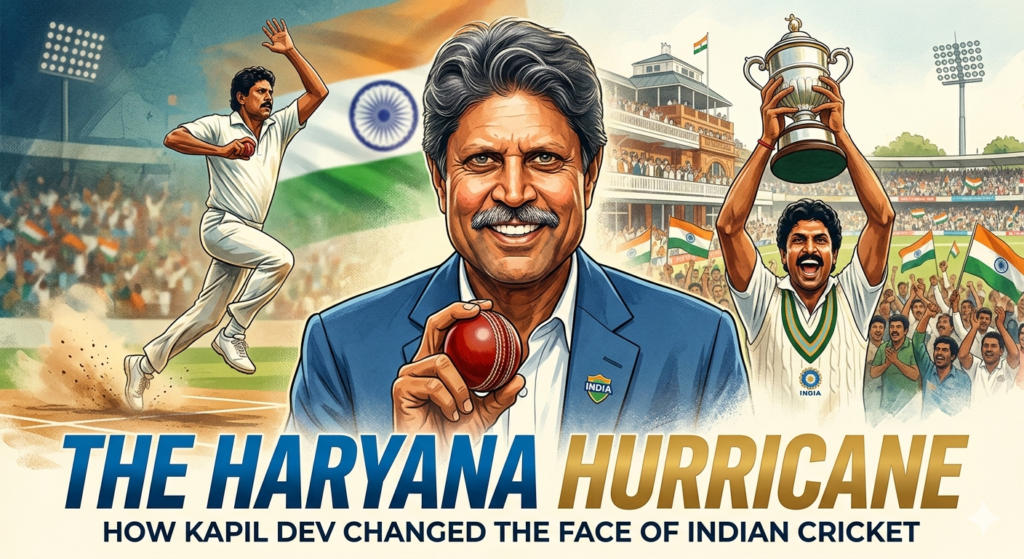
Discover the legendary journey of Kapil Dev, the “Haryana Hurricane.” Explore his iconic 1983 World Cup win, career stats, and his lasting legacy on Indian cricket.
Introduction
For decades, Indian cricket was defined by a specific kind of elegance—silky wristwork, defensive masterclasses, and a spin-heavy bowling attack. But in the late 1970s, a young man from Chandigarh arrived with a different philosophy. He didn’t just play cricket; he attacked it. With a leap in his delivery stride and a bat that swung like a scythe, Kapil Dev Nikhanj, affectionately known as the “Haryana Hurricane,” single-handedly transformed India from a team of participants into a nation of world-beaters.
The Dawn of a New Era
Born on January 6, 1959, Kapil Dev’s entry into international cricket in 1978 was nothing short of a cultural shock. At the time, India was famous for its “Spin Quartet,” and the idea of a genuine Indian fast bowler was almost mythical. Kapil changed that narrative. Making his debut against Pakistan in Faisalabad, he startled batsmen with sheer pace and a natural outswinger that would soon become his lethal trademark.
His impact was immediate. Unlike the defensive mindsets of the past, Kapil brought an aggressive, “never-say-die” attitude. By 1979, he had already established himself as a premier all-rounder, achieving the double of 1,000 runs and 100 wickets in just 25 Test matches—at the time, the youngest player ever to do so.
1983: The Miracle at Lord’s
The defining chapter of Kapil Dev’s career—and indeed, Indian sporting history—is the 1983 Prudential World Cup. Entering the tournament as 66-to-1 underdogs, the Indian team was expected to exit in the group stages.
Two moments from this tournament remain etched in the halls of greatness:
- The 175 against Zimbabwe:* With India reeling at 17/5 in a must-win game at Tunbridge Wells, Kapil Dev walked to the crease. What followed was a rescue act of such magnitude that it remains one of the greatest ODI innings ever played. He smashed 175 runs off 138 balls, a feat that wasn’t even televised due to a BBC strike, but lived on through the eyewitness accounts of the few lucky spectators.
- The Catch to Dismiss Viv Richards: In the final against the mighty West Indies, India was defending a meager 183. When Viv Richards began to take the game away, Kapil Dev ran backward for over 20 yards to pluck a sensational catch out of the air. It was the turning point that broke the West Indian spirit and led India to its first World Cup title.
A Master of All Trades: The Stats
Kapil Dev’s longevity is as impressive as his peak performances. He was a marathon man who rarely missed a game due to injury—a rarity for a fast bowler.
| Format | Matches | Runs | Wickets | Best Bowling |
| Test | 131 | 5,248 | 434 | 9/83 |
| ODI | 225 | 3,783 | 253 | 5/43 |
In 1994, Kapil surpassed Sir Richard Hadlee’s record to become the highest wicket-taker in Test history at the time with 434 wickets. He remains the only player in the history of the game to have achieved the incredible double of 400+ wickets and 5,000+ runs in Test cricket.
The All-Rounder’s Craft
What made Kapil Dev special wasn’t just his ability to do both, but his ability to do both at an elite level. As a bowler, his action was a thing of beauty—a rhythmic run-up followed by a classic side-on delivery. His outswinger was a nightmare for right-handers, while his yorkers were pinpoint.
As a batsman, he was the original “pinch hitter.” Long before T20 cricket made aggressive batting the norm, Kapil was clearing boundaries with ease. Whether it was hitting four consecutive sixes against England to avoid a follow-on or stabilizing a collapsing middle order, he was the ultimate “X-factor” for India.
Life Beyond the Boundary
Retiring in 1994 didn’t mean Kapil Dev stepped away from the limelight. He served a brief stint as the coach of the Indian national team and later became a prominent commentator, known for his candid and often witty analysis.
He also transitioned into a highly successful businessman and investor. Today, his portfolio—estimated at over ₹270 crore—includes ventures in hospitality, lighting (Dev Musco Lighting), and even technology. He is an avid golfer, often competing in senior amateur tournaments, proving that the competitive fire of the Haryana Hurricane still burns bright.
Legacy: The Father of Indian Pace
Perhaps Kapil Dev’s greatest legacy is not the trophies or the records, but the inspiration he provided. Before Kapil, India didn’t believe it could produce world-class fast bowlers. Today, India’s pace battery is feared across the globe, and every one of those bowlers stands on the shoulders of the man who first showed them it was possible.
In 2002, Wisden named him the “Indian Cricketer of the Century,” an honor that perfectly encapsulates his impact. Kapil Dev wasn’t just a player; he was a revolution. He taught a billion people how to win, how to fight, and how to dream of global glory.
Frequently Asked Questions (FAQs)
Q: What is Kapil Dev’s highest score in ODIs?
A: His highest score is 175*, scored against Zimbabwe during the 1983 World Cup.
Q: When did Kapil Dev retire from international cricket?
A: He retired in 1994 after a career spanning 16 years.
Q: Has Kapil Dev won any civilian awards?
A: Yes, he has been honored with the Padma Shri (1982) and the Padma Bhushan (1991) by the Government of India.
The Sultan of Bollywood: A Deep Dive into the Phenomenon of Salman Khan-2026 ( Bhaijaan)