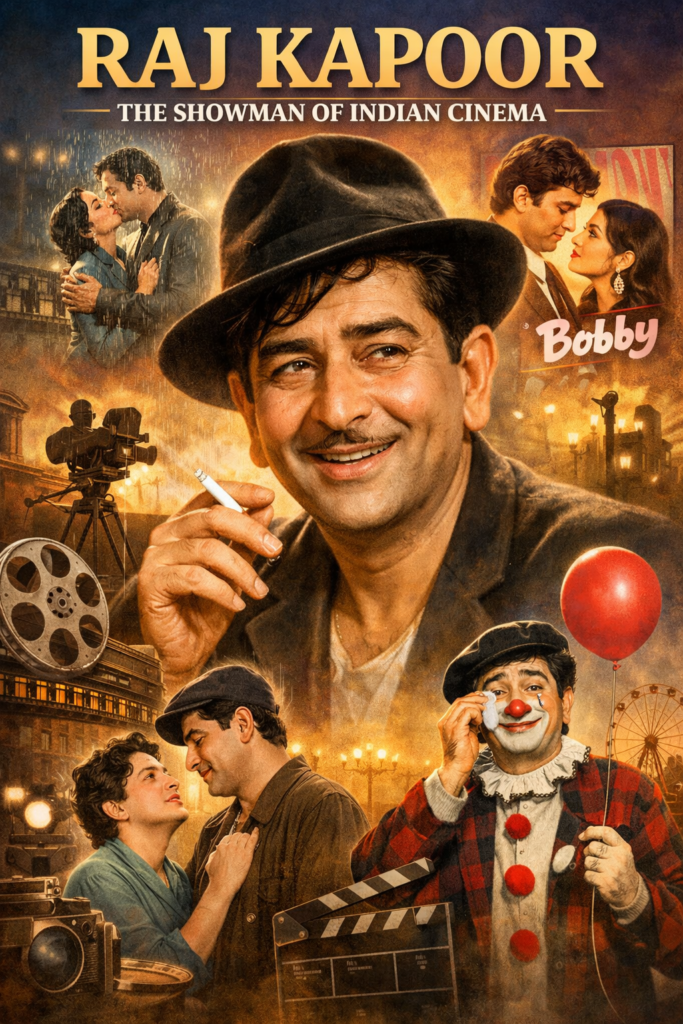
Discover the life, legacy, and cinematic brilliance of Raj Kapoor, the legendary showman of Indian cinema. Explore his iconic films, influence, and timeless contribution to Bollywood.
Introduction
Few names in Indian cinema command the reverence and admiration that Raj Kapoor does. Often hailed as “The Showman of Bollywood,” Raj Kapoor was more than just an actor—he was a visionary filmmaker, producer, and storyteller who redefined the emotional and artistic landscape of Indian cinema. From his unforgettable performances to his groundbreaking direction, Kapoor’s influence continues to echo through generations of filmmakers and movie lovers alike.
Early Life and Background
Raj Kapoor was born on December 14, 1924, in Peshawar (now in Pakistan), into a family deeply rooted in theatre and performance. He was the son of Prithviraj Kapoor, a pioneer of Indian theatre and cinema. Growing up in such an environment, Raj Kapoor was naturally drawn toward the world of acting and storytelling.
Despite his privileged exposure, his journey was not handed to him easily. He started from the ground up—working as a clapper boy in film studios before eventually stepping into acting roles. This hands-on experience shaped his understanding of cinema from both technical and emotional perspectives.
Rise to Stardom
Raj Kapoor made his acting debut as a lead in Neel Kamal (1947), but it was his directorial debut, Aag, that showcased his creative ambition. However, true stardom came with Barsaat, which established him as a leading actor and filmmaker.
In 1948, at just 24 years old, he founded RK Films, making him one of the youngest film directors in India. This studio would go on to produce some of the most iconic films in Bollywood history.
The Tramp Persona and Global Appeal
Raj Kapoor is often compared to Charlie Chaplin, and rightly so. His portrayal of the lovable underdog—the poor but kind-hearted man navigating a harsh world—resonated deeply with audiences.
Films like Shree 420 and Awara immortalized this “tramp” persona. Awara, in particular, became a massive international success, especially in countries like the Soviet Union and China. Kapoor’s ability to blend social commentary with entertainment gave his films a universal appeal.
Iconic Films and Storytelling Genius
Raj Kapoor’s filmography is filled with masterpieces that continue to be celebrated for their storytelling, music, and emotional depth. Some of his most notable works include:
- Awara – A powerful story about fate, crime, and redemption
- Shree 420 – A critique of urban corruption and materialism
- Sangam – A grand romantic drama exploring friendship and love
- Mera Naam Joker – A deeply personal and philosophical film
- Bobby – A trendsetting teenage romance
His films often featured memorable music composed by the legendary duo Shankar–Jaikishan, with lyrics by Shailendra and Hasrat Jaipuri. Songs were not just add-ons—they were integral to the narrative.
Collaboration and On-Screen Chemistry
. Their on-screen chemistry became legendary, especially in films like Awara and Shree 420. Together, they created some of the most iconic romantic moments in Indian cinema.
Kapoor also played a crucial role in launching and nurturing talent. His film Bobby introduced Rishi Kapoor and Dimple Kapadia, marking a new era of youthful romance in Bollywood.
Themes and Cinematic Style
Raj Kapoor’s films often revolved around themes of social justice, love, poverty, and human dignity. He had a unique ability to present serious issues in an entertaining format, making them accessible to the masses.
His storytelling style was deeply influenced by realism, yet he never shied away from grandeur. Lavish sets, emotionally charged performances, and melodious music were hallmarks of his cinema. He believed that films should not only entertain but also provoke thought and empathy.
Challenges and Comebacks
Despite his immense success, Raj Kapoor faced significant setbacks. Mera Naam Joker, one of his most ambitious projects, failed commercially upon release, causing a major financial crisis for RK Films.
However, Kapoor made a remarkable comeback with Bobby, which became a blockbuster and revived his production house. This resilience demonstrated his unwavering belief in his craft and audience.
Awards and Recognition
Raj Kapoor received numerous accolades throughout his career. He was honored with the Dadasaheb Phalke Award, recognizing his lifetime contribution to Indian cinema. He also received several Filmfare Awards and international recognition for his work.
In 1988, he was awarded the Padma Bhushan, one of India’s highest civilian honors.
Legacy and Influence
Raj Kapoor’s legacy is deeply embedded in the fabric of Indian cinema. His influence can be seen in the works of countless filmmakers who followed. Directors like Rajkumar Hirani and actors across generations have drawn inspiration from his storytelling techniques and emotional depth.
The Kapoor family continues to be a dominant force in Bollywood, with multiple generations contributing to the industry. RK Films remains a symbol of cinematic excellence.
Conclusion
Raj Kapoor was not just a filmmaker—he was a storyteller who understood the pulse of the people. His films transcended language and geography, touching hearts across the world. Whether it was the innocence of his characters or the depth of his narratives, Kapoor created a cinematic universe that remains timeless.
Even decades after his passing in 1988, Raj Kapoor’s work continues to inspire, entertain, and educate. He truly earned the title of “The Showman,” leaving behind a legacy that will forever shine in the history of Indian cinema.
Narendra Modi: Leadership, Vision, and Transformation of Modern India